





















Before Ordering a Printed T-Shirt, Check These Colour Quality Secrets

Have you ever spent hours perfecting a design for your brand or team, only to have the box arrive and find that the colours look nothing like what you saw on your screen? It is a frustrating moment that many business owners and event organisers face. You might think that what you see on your laptop is exactly what will appear on the fabric, but there is a bit of a science to it. Whether you are looking for t shirt printing for a local Birmingham trade business or planning a large promotional event, getting the colour right is the difference between a professional look and a DIY disaster.
In this guide, we are going to pull back the curtain on how colour works in the world of garment decoration. We want to make sure your next printed T-Shirt order looks vibrant, sharp, and exactly how you imagined it.
Why colour quality matters for your brand
When we talk about custom printed t-shirt quality, we aren’t just talking about the fabric. We are talking about how the ink sits on the fabric and how the colours represent your identity. If your company logo is a specific shade of navy, receiving a batch of shirts that look royal blue can really hurt your brand consistency. Let’s look at the secrets that help you avoid these common pitfalls.
Secret 1: The digital screen vs. physical ink trap
One of the biggest secrets in the industry is the “RGB vs. CMYK” struggle. Your computer screen uses light to create colours (RGB), while printers use ink (CMYK or Pantone). Screens are backlit, making every colour look glowing and bright. Ink on a cotton shirt does not have a backlight.
- The brightness factor: Colours often appear a shade or two darker on fabric than they do on a glowing monitor.
- Fabric absorption: Cotton is a natural fibre that soaks up ink, which can slightly mute the vibrancy compared to a glossy paper print.
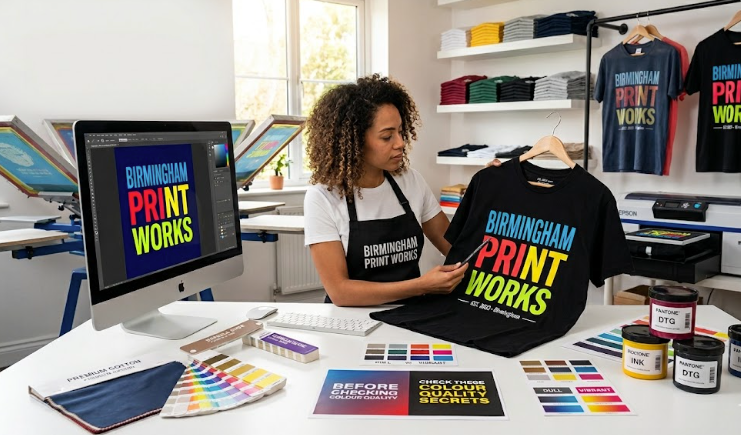
- The solution: Always ask for a digital proof. At Signature Supplies, we provide these to help you see how the placement and tone will work before any ink touches the cloth.
Secret 2: screen printing vs DTG printing for colour depth
Choosing the right method is vital for high quality t-shirt printing results. Not every design works for every machine. If you have a simple logo with solid, bold colours, screen printing is often the king of vibrancy. However, if you have a photograph or a design with many gradients, Direct-to-Garment (DTG) might be better.
| Feature | Screen Printing | DTG Printing |
| Colour Vibrancy | Extremely high and opaque | Very good but more matte |
| Best For | Bold logos and large batches | Detailed photos and small runs |
| Texture | Sits on top of the fabric | Sinks into the fibres |
| Durability | Excellent for workwear | Great for fashion and retail |
Secret 3: fabric and ink quality for t-shirt printing
The material you choose acts as the canvas for your art. If you pick a very thin or low-quality fabric, the ink might “bleed” or look patchy. For a long lasting printed t-shirt design, the relationship between the weight of the cotton and the type of ink used is everything.
- Ring-spun cotton: This provides a smoother surface for the ink to sit on, leading to a much crisper image.
- Ink elasticity: High-quality inks need to stretch with the shirt. If the ink is cheap, it will crack the first time you put the shirt on.
- Base layers: On dark shirts, a “white underbase” is needed. Without this secret layer, your yellow or red print will look dull because the dark fabric “eats” the colour.
Checking the t-shirt printing colour durability
You don’t want your printed T-Shirt to look amazing on Monday and faded by Friday. Durability depends on the curing process. In our Birmingham facility, we time the heat pressing and curing stages perfectly. This locks the colour into the fibres. You can test the quality of a print by gently stretching the fabric; the ink should move with the shirt and snap back without showing the fabric colour underneath.
Real-life example: The “Neon” disappointment
Imagine a local gym that wants “Electric Green” shirts for their personal trainers. They find a bright neon green on a web design tool. When the printed T-Shirt arrives, it looks like a standard grass green. This happens because “Electric” neon colours are very difficult to replicate with standard inks. If you want those “pop” colours, you need to talk to your printer about specific fluorescent inks or Pantone matching. It’s these small details that save you from a costly mistake.
What to look for in your digital proof
Before you hit the “order” button, your printer should send you a proof. This is your last chance to catch errors. Don’t just glance at it; look deeply at these areas:
- Hex Codes and Pantones: If you have brand guidelines, check that the printer is using your specific colour codes.
- Sizing vs. Scale: A logo might look big on a small shirt but tiny on an XXL. Make sure the scale is consistent.
- Spelling: It sounds simple, but you would be surprised at how many people miss a typo because they were too focused on the colour!
Ensuring a long lasting printed t-shirt design
Once you have your high-quality shirts, you play a part in keeping those colours fresh. We always recommend washing your custom gear inside out and avoiding high-heat dryers. This protects the bond between the fabric and ink quality for t-shirt printing and keeps your team looking sharp for months rather than weeks.
Tips for a perfect order every time
If you are feeling a bit overwhelmed by the technical side, don’t worry. Most people aren’t print experts, and that is why we are here to help. Here is a quick checklist for your next project:
- Use Vector Files: Files ending in .AI, .EPS, or .PDF (vectors) stay sharp no matter how much we resize them. Avoid small, blurry JPEGs.
- Consider the shirt colour: Printing a light blue logo on a navy shirt might result in low contrast. Always think about how the background colour affects the print.
- Ask about the ink: Ensure your supplier is using industry-standard inks that are eco-friendly and wash-fast.
- Trust the experts: If a printer tells you that a certain colour won’t work on a specific fabric, listen to them! They want your printed T-Shirt to look as good as you do.
Summary of Colour Quality Secrets
| Secret | Why it matters |
| Underbasing | Keeps colours bright on dark fabrics |
| Vector Art | Prevents blurry or “pixelated” edges |
| Curing Time | Stops the print from peeling after one wash |
| Pantone Matching | Ensures your brand logo is the exact same every time |
Frequently Asked Questions
How should I wash my printed T-shirt to keep the design looking bold?
To keep your t-shirt printing colour durability high, just wash the garment inside out on a cool setting and skip the tumble dryer. This simple habit stops the ink from cracking and secures a long lasting printed t-shirt design.
What is the best quality t-shirt material for printing?
For high quality t-shirt printing, we recommend 100% ring-spun cotton. The smoother the weave, the better the fabric and ink quality for t-shirt printing will interact. This creates a flatter surface that allows the ink to bond tightly without “pilling” or looking fuzzy over time.
Why does my logo colour look different on a dark shirt?
For dark materials, the application of an underbase is necessary for the printing process. Failure to do this causes the colouring material to reflect the darkness of the material, making the ink look murky. Professional custom printed t-shirt quality depends on this hidden layer to make your colours pop and stay true to your brand.
Screen printing versus DTG printing: which produces more lasting prints?
Both processes have their advantages, but the best between screen printing vs DTG printing comes down to personal preference and use case. The screen printing process is known to be very durable because it uses highly pigmented ink, which makes it perfect for producing wear-and-tear resistant apparel.
Let’s create something professional together
Choosing a local partner like Signature Supplies means you have experts overseeing your printed T-shirt from the first stitch to the final press. We focus on vibrant, durable results because we know these garments represent your brand’s hard work. Whether you need a single item or a full staff set of personalised hoodies, we use our industry secrets to make every piece look incredible. Browse our range today or visit our Birmingham office to see our quality in person. Let’s make sure your next project is the one that everyone notices for all the right reasons.